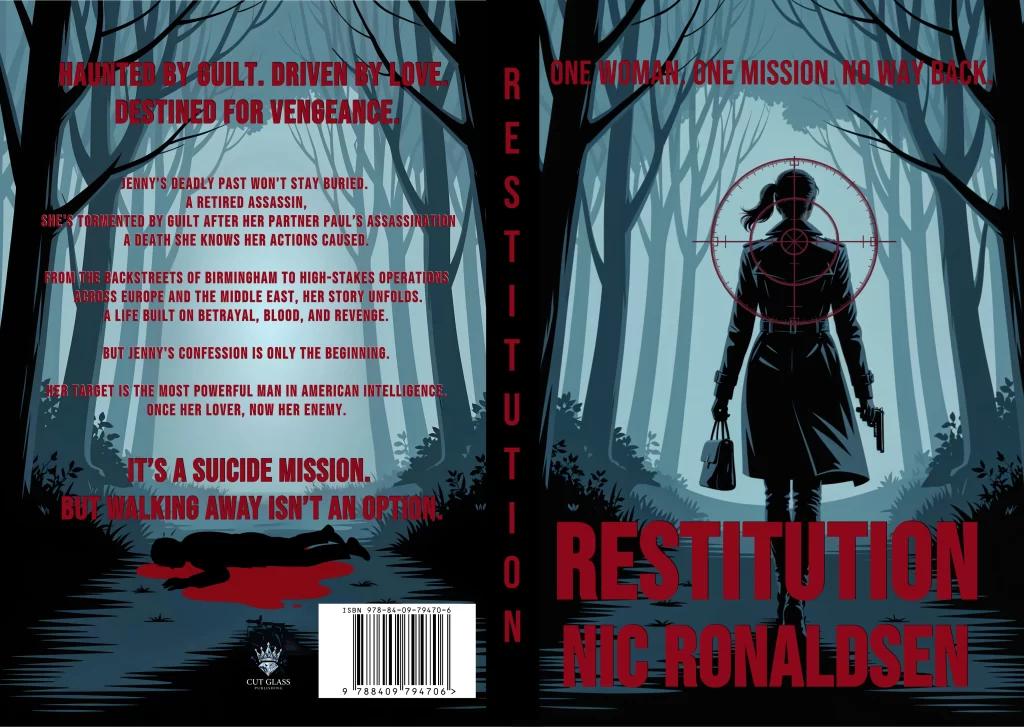
So — what’s Restitution about?
Restitution is an action thriller designed to grip the reader from start to finish, but at its heart it is a story about integrity, cost, and consequence.
The novel follows Jenny Robson, a retired UK government assassin, as she relives her past while preparing to take vengeance against one of the most powerful men in American intelligence.
Jenny’s life has been shaped by danger and personal tragedy, and it is this history that now drives her forward. As she recounts her past to Jamie and Sarah, however, she begins to question her own values and the moral certainty of what she intends to do. The price of vengeance is almost certainly her life. The alternative is to walk away and live the life she has always dreamed of — knowing that she may be doing so as a damaged person who failed to right a wrong.
That dilemma lies at the core of Restitution.
How far do you go to be true to yourself, and at what cost?
This question — quisque sibi verus (“to thine own self be true”) — sits at the moral center of the novel.
For most of us, integrity defines who we believe we are. Yet integrity always comes with a cost, whether that cost is inconvenience, loss of opportunity, financial sacrifice, damaged relationships, or personal risk.
At what point do we decide that the price of doing the right thing is simply too high? And if we make that choice, can we honestly believe that we remain the same person afterward?
The personal cost of compromise
Most of us can remember moments when we acted in ways that were not true to ourselves. For some, those moments leave a lingering ache of regret that lasts a lifetime. Ideally, such experiences should strengthen our resolve to never compromise our integrity again.
For many people, however, integrity is treated as a vague and disposable concept — something that is quickly abandoned when it becomes inconvenient or costly. I fear this mindset is increasingly common, particularly among politicians, and may help explain why Western societies feel so unstable today.
Our democracies are built on decency and the rule of law, yet both demand sacrifice to uphold them. Without that willingness, the structures themselves begin to weaken.
Jenny’s dilemma
The conundrum that tortures Jenny — and increasingly Jamie — is how far one is willing to go to act with integrity.
For Jenny, the stakes could not be higher. Failure means death. Success may also mean the destruction of a fragile new relationship that she deeply treasures.
As the pressure mounts, Jenny is pushed to the brink of emotional collapse. Will she really risk everything to right a wrong, knowing the likely cost? Or will fear and exhaustion finally force her to back down?
And, uncomfortably, the novel asks the reader the same question:
What would you do in her position?
Integrity at the level of nations
Beneath Jenny’s personal struggle lies a broader question about how our countries are governed. The same issue of integrity applies not only to individuals but to democracies themselves.
The concept of “doing the right thing” seems increasingly absent in both the UK and the US. This is evident in conflicts such as Iraq and Afghanistan — where Jenny served — and more recently in responses to Gaza and Ukraine.
These decisions are often framed as necessity or pragmatism, yet they frequently come at enormous human cost and moral compromise.
War, damage, and disillusionment
Jenny is a veteran of Afghanistan, a war that became the longest in US history and left countless service personnel physically and psychologically damaged.
Like many who join the military, she believed she was serving a greater good. Later, when she moved into intelligence work, she hoped to make a meaningful difference.
Instead, she discovered that many operations had little to do with justice and far more to do with political expediency and financial interests. How many service members have found themselves in that position — and paid for it with their lives, their health, or their sanity?
What Restitution is really about
Ultimately, Restitution is about integrity — and the emotional trauma of resisting the temptation to walk away when doing the right thing becomes unbearable.
For Jenny, the option of backing down becomes ever more complex until she stands at the edge of collapse.
The novel does not offer easy answers. It asks a single, uncomfortable question and leaves it with the reader:
What would you do?